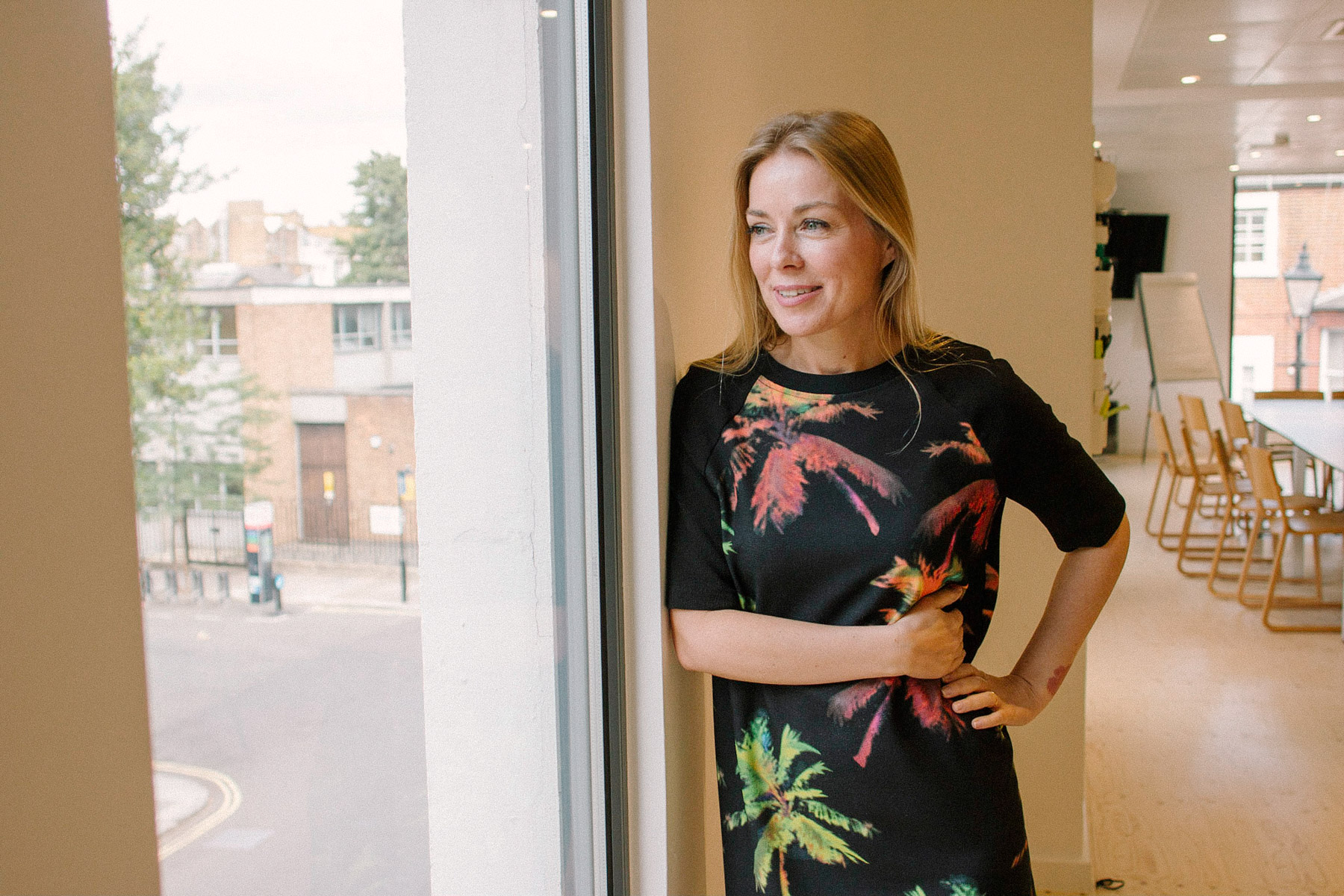
Have you met Sairah yet?
3 minute read
Having been at Wolff Olins for 23 years, most recently as COO,
Sairah Ashman took over as CEO last summer. Ahead of her talk at
Collision
next month (a US tech conference to rival SXSW), she spoke with the
organizers about the overlap between technology and sociology.
Hi Sairah! Congratulations on your promotion to CEO.
How have you found that transition?
Stepping into the CEO role has been an enjoyable challenge. Dame
Cilla Snowball (Chair and group CEO of AMV BBDO) memorably advised that when you take on
this kind of role all the easy stuff is solved before it reaches you –
you get the more interesting tricky stuff. She’s right and every day
is different.
The fact I’ve been in the business and at Wolff Olins for so long
has made it smooth. That said it takes time to develop your agenda,
build your team and determine where best to spend your time. I wouldn’t
say I’m there yet. I’ve spent my first 6 months getting a feel for
where I can have the most impact and what needs to be in place to make
us successful. Success for me is about creating value for our clients,
making Wolff Olins the best place you can work in our field and becoming
better known for both.
You’ve been at Wolff Olins since 1994. In today’s
world, people rarely stay in the one place so long. Do you see any
advantages, or indeed disadvantages, to doing so?
Culture and connection is key for me. The more part of a place you
become the more you’re able to influence and contribute to it. If it’s
the right place for you then I think it’s a smart move to invest the
time. You get to know how things work, what makes the place tick and
how to do more of the things you enjoy. The credibility and network
you build gives you a lot of freedom to experiment, expand your scope,
enjoy what you do and have an impact.
People and culture are a huge part, as well as the challenging
problems we get to solve for progressive and often global clients. It’s
a powerful combination. Whenever I’ve felt like I’m about to plateau
or become bored I’ve found a way to keep growing, through taking on
unusual projects, new roles or some pretty substantial learning. It’s
kept me interested and excited.
Moving around regularly might help you progress through roles faster,
build a more diverse network, and get a deeper insight into different
types of companies and environments. At the end of the day you have to
decide what’s right for you.
You have a masters in digital sociology. How do
you see the world of tech and sociology overlap?
They’re intrinsically linked and feed each other. How we behave affects
how technology develops. Likewise, how technology evolves informs how
we behave. It’s a virtuous circle. Intelligence in machines is obviously
the interesting and hot topic right now. That intelligence is able to
move faster and increasingly beyond our own. Digital objects exchange
with each other in ways we don’t always control and the ‘decisions’ they
make can have huge consequences. We’re experiencing a unique moment in
time in developmental terms.
This new kind of intelligence has the capacity to enhance our experience
of being a human being or to diminish it. As such, I think it’s important
to be ambitious and optimistic while proceeding with extreme caution
and forethought.
I take the view that progress in technology is fundamentally a good
thing, but progress at any price is not. We need to talk about this more,
both globally and politically.
You’ve spoken of your interest in AI. Could you
share why that excites you?
The range of applications or problems AI could solve is enormous as
it rapidly evolves way beyond our own ability to conceptualise and process
information.
The most exciting developments for me are in the area of critical
systems. Take healthcare as an example. The ability to process, analyse
and apply learnings from huge data sets of information being added to
in real-time means better outcomes for us all. The same in a laboratory
setting will speed up the development of new ‘cures’, as well as the
forms they could take. The same goes for helping us manage our health
more proactively through AIs being integrated into our everyday lives
to head off potential issues further down the line. Imagine living in
this world, it’s not very far away.
Many people are cautious of AI.
Yes and we’re right to be. There’s no single organizing principle
for the development of AI practices and applications. The ethics
surrounding this topic are fraught with danger. Who do we trust when
AI increasingly has the ability to control our access to information,
services and resources? We shouldn’t leave this in the hands of one
institution, organisation or nation to decide. Self-interest and the
drive for personal gain must be overcome, and a universal set of
principles adhered to in order to ensure safety, security and benefits
for all. I don’t want a single government, business or tech billionaire
controlling these choices on behalf of humanity. Neither should you.
We need some clear checks and balances in place.
You will be joining us at creatiff at Collision.
What big themes do you expect to see while there?
The use of AI, data and personalization will continue to be big themes.
How do you advertise your products and services via Alexa or through
Amazon? When shopping is effectively being de-branded and consumers
are being served up default products at the will of a commerce platform?
How do you create loyalty and trust in this more transactional sales
environment? We’re now living in a world of ambient technology primed
for response and recall, how do you build an emotional connection and
is it relevant to do so? I hope to see some innovative responses to
these questions.
Email us to connect with Sairah
Don’t miss her at the event